Exporting a Modpack
To export your modpack, run the pakku export command:
Pakku will export your modpack in the following formats depending on your target:
- CurseForge (
.zip) format if your target is
curseforgeormultiplatform
path:
./build/curseforge/<output_file>
- Modrinth (
.mrpack) format if your target is
modrinthormultiplatform
path:
./build/modrinth/<output_file>
- ServerPack (
.zip) format path:
./build/serverpack/<output_file>
The <output_file> is based on your modpack's name and version.
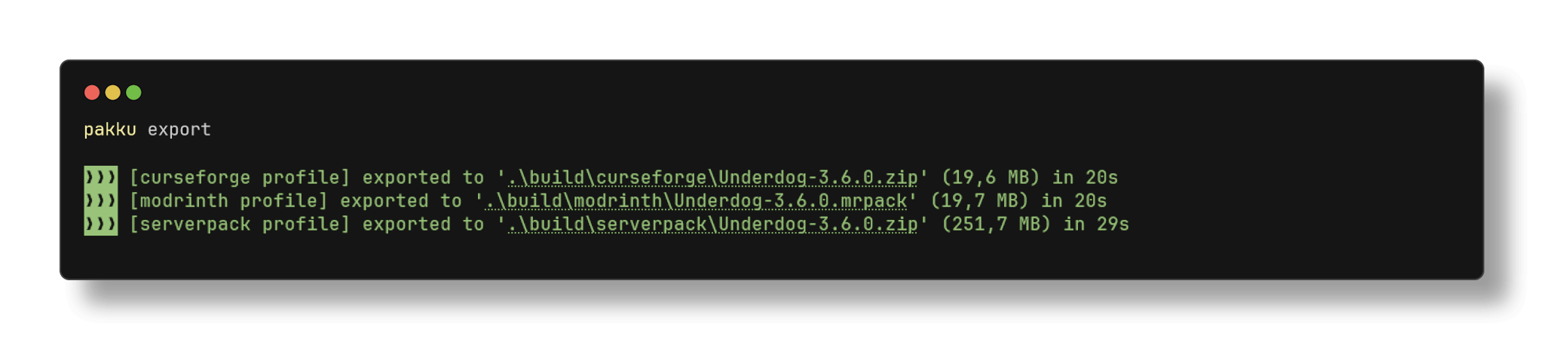
Example output:
Export Without Server Content
Use the --no-server option to export a modpack without server-side content:
Server-Side Mod Handling
Use the export_server_side_projects_to_client configuration option to control how server-side mods are included in client modpack exports.
How It Works?
Pakku uses an export profile system under the hood. Currently, it is only possible to export the default profiles (curseforge, modrinth and serverpack). However, exposing this functionality to users using scripting is planned for the v2.0.
Benefits from export profile system:
Export profiles consist of number of export rule which control what happens on exporting.
Export rules are purely functional.
Each profile is independent and results in one exported file.
Multiplatform Modpacks
Handling of projects in a multiplatform modpack:
File Director Integration
If your modpack contains File Director, Pakku will automatically add missing projects to its config, instead of packing them as overrides.